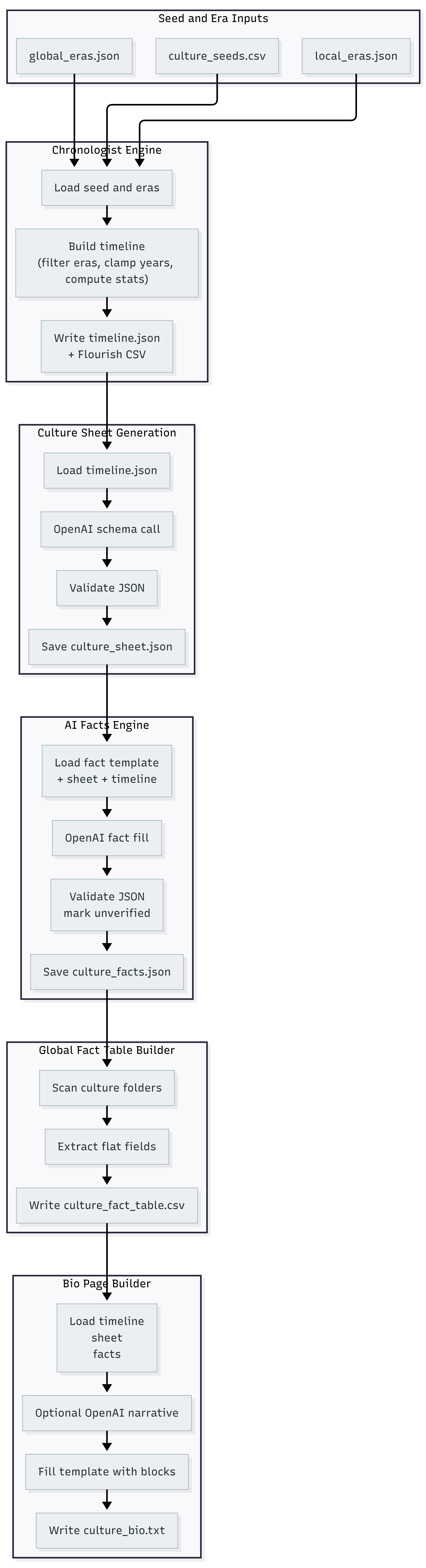
This example shows the full set of files produced from a single seed CSV row for the Choctaw, an Indigenous Nation of the Southeastern Woodlands whose ancestral homelands span present-day Mississippi, Alabama, and Louisiana.
Click to expand file contents:
seed_row (CSV input) Pipeline input
culture_id      culture_name   region_tags                     earliest_year_ce   latest_year_ce
choctaw         Choctaw        "southeastern_us; muskogean"    -8000              2025
timeline.json Chronologist output
{
  "culture_id": "choctaw",
  "culture_name": "Choctaw",
  "timeline": [
    {
      "era_key": "archaic",
      "era_name": "Archaic Period",
      "start_year_ce": -8000,
      "end_year_ce": -1000,
      "description": "Diversified subsistence, regionalization, expanded toolkits, early plant management.",
      "duration_years": 7000,
      "fraction_of_culture_span": 0.6982543640897756,
      "global_context": [
        {
          "global_era_key": "neolithic_early_agriculture",
          "name": "Neolithic / Early Agricultural Era",
          "description": "Emergence of agriculture, early permanent settlements, and domesticated plants and animals in several regions."
        },
        {
          "global_era_key": "bronze_age",
          "name": "Bronze Age",
          "description": "Bronze metallurgy and early complex urban societies in parts of Eurasia and North Africa."
        },
        {
          "global_era_key": "iron_age_classical",
          "name": "Iron Age and Classical Antiquity",
          "description": "Spread of iron technologies, classical empires, and major philosophical and religious traditions."
        }
      ]
    },
    {
      "era_key": "woodland",
      "era_name": "Woodland Period",
      "start_year_ce": -1000,
      "end_year_ce": 800,
      "description": "Pottery, mound-building, horticulture, growing social complexity.",
      "duration_years": 1800,
      "fraction_of_culture_span": 0.17955112219451372,
      "global_context": [
        {
          "global_era_key": "iron_age_classical",
          "name": "Iron Age and Classical Antiquity",
          "description": "Spread of iron technologies, classical empires, and major philosophical and religious traditions."
        },
        {
          "global_era_key": "medieval",
          "name": "Medieval Period",
          "description": "Growing states, trade, and cultural flowering in many parts of Eurasia and Africa; pre-contact florescence in the Americas."
        }
      ]
    },
    {
      "era_key": "classic_florescence",
      "era_name": "Classic / Florescence Period",
      "start_year_ce": 800,
      "end_year_ce": 1500,
      "description": "High refinement period with large ritual centers, complex social hierarchies, long-distance trade.",
      "duration_years": 700,
      "fraction_of_culture_span": 0.06982543640897755,
      "global_context": [
        {
          "global_era_key": "medieval",
          "name": "Medieval Period",
          "description": "Growing states, trade, and cultural flowering in many parts of Eurasia and Africa; pre-contact florescence in the Americas."
        },
        {
          "global_era_key": "early_modern",
          "name": "Early Modern Period",
          "description": "Age of exploration, colonial expansion, scientific revolution, and large-scale global exchanges."
        }
      ]
    },
    {
      "era_key": "protohistoric",
      "era_name": "Protohistoric Period",
      "start_year_ce": 1500,
      "end_year_ce": 1650,
      "description": "European presence and indirect impacts (trade goods, disease) before sustained direct documentation.",
      "duration_years": 150,
      "fraction_of_culture_span": 0.014962593516209476,
      "global_context": [
        {
          "global_era_key": "medieval",
          "name": "Medieval Period",
          "description": "Growing states, trade, and cultural flowering in many parts of Eurasia and Africa; pre-contact florescence in the Americas."
        },
        {
          "global_era_key": "early_modern",
          "name": "Early Modern Period",
          "description": "Age of exploration, colonial expansion, scientific revolution, and large-scale global exchanges."
        }
      ]
    },
    {
      "era_key": "colonial_contact",
      "era_name": "Colonial / Contact Period",
      "start_year_ce": 1600,
      "end_year_ce": 1800,
      "description": "Direct sustained contact with European powers; missions, forts, new trade systems, conflict and cultural change.",
      "duration_years": 200,
      "fraction_of_culture_span": 0.0199501246882793,
      "global_context": [
        {
          "global_era_key": "early_modern",
          "name": "Early Modern Period",
          "description": "Age of exploration, colonial expansion, scientific revolution, and large-scale global exchanges."
        },
        {
          "global_era_key": "industrial_modern",
          "name": "Industrial and Modern Era",
          "description": "Industrialization, nation-state consolidation, world wars, and mass technological change."
        }
      ]
    },
    {
      "era_key": "removal_reservation",
      "era_name": "Removal / Reservation Era",
      "start_year_ce": 1800,
      "end_year_ce": 1880,
      "description": "Treaties, forced relocations, reservation systems, intense cultural disruption and survival strategies.",
      "duration_years": 80,
      "fraction_of_culture_span": 0.00798004987531172,
      "global_context": [
        {
          "global_era_key": "early_modern",
          "name": "Early Modern Period",
          "description": "Age of exploration, colonial expansion, scientific revolution, and large-scale global exchanges."
        },
        {
          "global_era_key": "industrial_modern",
          "name": "Industrial and Modern Era",
          "description": "Industrialization, nation-state consolidation, world wars, and mass technological change."
        }
      ]
    },
    {
      "era_key": "nationhood_reorganization",
      "era_name": "Nationhood / Reorganization Era",
      "start_year_ce": 1880,
      "end_year_ce": 1950,
      "description": "Reorganization of governance structures, legal recognition struggles, boarding schools, early revitalization.",
      "duration_years": 70,
      "fraction_of_culture_span": 0.006982543640897756,
      "global_context": [
        {
          "global_era_key": "industrial_modern",
          "name": "Industrial and Modern Era",
          "description": "Industrialization, nation-state consolidation, world wars, and mass technological change."
        },
        {
          "global_era_key": "contemporary_global",
          "name": "Contemporary Global Era",
          "description": "Contemporary globalized world: decolonization, digital technologies, international institutions."
        }
      ]
    },
    {
      "era_key": "contemporary",
      "era_name": "Contemporary Cultural Era",
      "start_year_ce": 1950,
      "end_year_ce": 2025,
      "description": "Living cultures in the present: sovereignty movements, language revitalization, modern economies, art and political life.",
      "duration_years": 75,
      "fraction_of_culture_span": 0.007481296758104738,
      "global_context": [
        {
          "global_era_key": "industrial_modern",
          "name": "Industrial and Modern Era",
          "description": "Industrialization, nation-state consolidation, world wars, and mass technological change."
        },
        {
          "global_era_key": "contemporary_global",
          "name": "Contemporary Global Era",
          "description": "Contemporary globalized world: decolonization, digital technologies, international institutions."
        }
      ]
    }
  ],
  "stats": {
    "temporal": {
      "earliest_year": -8000,
      "latest_year": 2025,
      "total_span_years": 10025,
      "number_of_local_eras": 8,
      "mean_era_length_years": 1259.375,
      "median_era_length_years": 175.0
    },
    "contact": {
      "years_pre_contact": 9600,
      "years_post_contact": 475,
      "fraction_pre_contact": 0.9576059850374065,
      "fraction_post_contact": 0.04738154613466334
    }
  }
}
culture_sheet.json Structured culture sheet
{
  "overview": {
    "culture_name": "Choctaw",
    "primary_region": "Southeastern United States, primarily Mississippi, Alabama, and Louisiana",
    "environment_ecology": "Mixed hardwood forests, river valleys, and fertile floodplains supporting diverse flora and fauna",
    "time_depth_summary": "The Choctaw culture has roots extending back to the Archaic Period (~8000 BCE), evolving through Woodland and Mississippian periods, with complex societies evident by the Classic Florescence era. They experienced significant changes during European contact and removal in the 19th century, continuing as a living culture today."
  },
  "geography": {
    "homeland_boundaries": "Traditional territory encompassed central and southern Mississippi, parts of Alabama and Louisiana, bounded by the Mississippi River to the west and the Tombigbee River to the east",
    "neighboring_cultures": "Chickasaw to the north, Natchez to the south, Creek to the east, and various Muskogean-speaking groups",
    "seasonal_patterns": "Seasonal cycles influenced hunting, fishing, and agriculture, with planting in spring, harvesting in late summer and fall, and hunting and gathering in winter"
  },
  "social_structure": {
    "governance": "Decentralized chiefdoms led by hereditary chiefs (miko) and councils of elders; leadership balanced between civil and ceremonial roles",
    "clan_lineage_systems": "Matrilineal clans organized social identity, inheritance, and marriage alliances",
    "gender_roles": "Distinct but complementary roles; men primarily hunted and warred, women managed agriculture, domestic tasks, and clan lineage",
    "family_structure": "Extended families within clans formed the basic social units, emphasizing kinship ties and communal responsibilities"
  },
  "economy": {
    "food_sources": "Hunting deer, turkey, and small game; fishing; gathering wild plants; supplemented by cultivated crops",
    "agriculture": "Cultivation of the 'Three Sisters': maize, beans, and squash, along with sunflowers and tobacco",
    "trade_networks": "Extensive trade with neighboring tribes and European settlers, exchanging deerskins, pottery, and agricultural products for European goods",
    "craft_specializations": "Skilled in basketry, pottery, textile weaving, and tool-making using local materials"
  },
  "technology": {
    "tools": "Stone and bone tools in pre-contact periods; adoption of metal tools post-contact; bows, arrows, and fishing implements",
    "architecture": "Wattle and daub houses with thatched roofs; ceremonial mounds and plazas during Mississippian influence",
    "transport": "Canoes crafted from hollowed logs for river travel; footpaths connecting villages and trade routes",
    "ceramics_metalwork": "Distinctive pottery with stamped and incised designs; limited native metalwork supplemented by European metal goods"
  },
  "language": {
    "language_family": "Muskogean",
    "dialects": "Several dialects historically spoken, including those of the Eastern and Western Choctaw groups",
    "oral_tradition_features": "Rich oral literature including myths, legends, and historical narratives transmitted through storytelling and ceremonial recitations"
  },
  "faith_and_ritual": {
    "primary_beliefs": "Animism with reverence for natural spirits, ancestors, and a Creator figure; emphasis on harmony with nature",
    "ritual_practices": "Ceremonies related to agriculture, hunting, healing, and social rites; Green Corn Ceremony as a central annual event",
    "sacred_symbols": "Symbols include the sun, corn, and animals such as the deer and eagle, representing life, sustenance, and spiritual power"
  },
  "art_and_symbolism": {
    "visual_arts": "Pottery decoration, beadwork, and basketry featuring geometric and natural motifs",
    "music_dance": "Use of drums, rattles, and flutes in social and ceremonial dances; songs often linked to storytelling and rituals",
    "storytelling": "Oral narratives conveying cultural values, history, and cosmology, performed by elders and designated storytellers"
  },
  "cultural_themes": [
    "Connection to land and nature",
    "Clan and kinship importance",
    "Balance between tradition and adaptation",
    "Resilience through cultural continuity",
    "Spiritual harmony and community cohesion"
  ],
  "sources": {
    "academic": [
      "Galloway, Patricia. Choctaw Genesis, 1500–1700. University of Nebraska Press, 1995.",
      "Swanton, John R. Early History of the Creek Indians and Their Neighbors. Smithsonian Institution, 1922.",
      "Kidwell, Clara Sue. Choctaws and Missionaries in Mississippi, 1818–1918. University of Oklahoma Press, 1995."
    ],
    "archaeological": [
      "Phillips, Philip, and James A. Brown. Archaeological Survey in the Lower Mississippi Alluvial Valley, 1940–1947. Peabody Museum, 1978.",
      "Williams, Stephen. Excavations at the Nanih Waiya Mound, Mississippi. Southeastern Archaeology, 1981."
    ],
    "ethnographic": [
      "Swanton, John R. The Choctaw of Bayou Lacomb, Louisiana. Bureau of American Ethnology Bulletin 145, 1946.",
      "Byington, Cyrus. A Dictionary of the Choctaw Language. Smithsonian Institution, Bureau of American Ethnology, 1915."
    ]
  }
}
culture_facts.json Expanded fact schema
{
  "culture_id": "choctaw",
  "culture_name": "Choctaw",
  "alt_names": [],
  "culture_group": "Native American",
  "subgroup": "Muskogean",
  "is_indigenous": true,
  "status": "Living culture",
  "primary_region": "Southeastern United States, primarily Mississippi, Alabama, and Louisiana",
  "secondary_regions": [],
  "latitude_min": 30.0,
  "latitude_max": 35.0,
  "longitude_min": -95.0,
  "longitude_max": -88.0,
  "climate_zone": "Temperate",
  "biome_type": "Mixed hardwood forests and river valleys",
  "coastal": false,
  "riverine": true,
  "mountainous": false,
  "island": false,
  "migration_type": "Sedentary with forced relocation (19th century)",
  "environmental_constraints": [
    "Seasonal climate variation",
    "Floodplain dynamics",
    "European colonization impacts"
  ],
  "major_food_animals": [
    "deer",
    "turkey",
    "small game"
  ],
  "major_food_plants": [
    "maize",
    "beans",
    "squash",
    "sunflowers",
    "tobacco"
  ],
  "wild_resources": [
    "wild plants",
    "fish"
  ],
  "key_minerals": [],
  "forested": true,
  "fertile_soils": true,
  "earliest_known_presence_year": -8000,
  "latest_known_presence_year": 2025,
  "total_time_span_years": 10025,
  "continuous_occupation": true,
  "era_count": 8,
  "average_era_length_years": 1259,
  "median_era_length_years": 175,
  "fraction_pre_contact": 0.958,
  "fraction_post_contact": 0.047,
  "estimated_population_peak": null,
  "estimated_population_pre_contact": null,
  "estimated_population_post_contact": null,
  "population_density_per_km2": null,
  "settlement_pattern": "Villages connected by footpaths along rivers",
  "avg_settlement_size": null,
  "kinship_residential_pattern": "Extended families within clans",
  "kinship_system_type": "Matrilineal",
  "clan_system": true,
  "clan_count": null,
  "lineage_type": "Matrilineal",
  "political_structure_type": "Decentralized chiefdoms",
  "centralized_authority": false,
  "roles_of_leadership": [
    "Hereditary chiefs (miko)",
    "Councils of elders"
  ],
  "conflict_resolution_methods": [],
  "social_stratification": "Complex social hierarchies during Classic Florescence; generally clan-based social organization",
  "gender_roles_summary": "Distinct but complementary; men hunted and warred, women managed agriculture and domestic tasks",
  "inheritance_rules": "Matrilineal inheritance",
  "primary_subsistence": "Agriculture (Three Sisters), hunting, fishing, gathering",
  "secondary_subsistence": [
    "Fishing",
    "Gathering wild plants"
  ],
  "major_crops": [
    "maize",
    "beans",
    "squash",
    "sunflowers",
    "tobacco"
  ],
  "domesticated_animals": [],
  "storage_technology": [],
  "seasonal_round": [
    "Planting in spring",
    "Harvesting in late summer and fall",
    "Hunting and gathering in winter"
  ],
  "trade_network_extent_km": null,
  "trade_partners": [
    "Neighboring tribes",
    "European settlers"
  ],
  "export_goods": [
    "Deerskins",
    "Pottery",
    "Agricultural products"
  ],
  "import_goods": [
    "European goods"
  ],
  "value_units": [],
  "long_distance_trade": true,
  "lithic_technology_type": "Stone and bone tools pre-contact",
  "metallurgy_level": "Limited native metalwork; adoption of European metal goods post-contact",
  "weapon_types": [
    "Bows and arrows",
    "Fishing implements"
  ],
  "tool_specializations": [
    "Basketry",
    "Pottery",
    "Textile weaving",
    "Tool-making"
  ],
  "housing_type": "Wattle and daub houses with thatched roofs",
  "permanent_architecture": true,
  "construction_materials": [
    "Wood",
    "Clay",
    "Thatch"
  ],
  "village_defenses": [],
  "transport_modes": [
    "Footpaths",
    "Canoes"
  ],
  "watercraft_types": [
    "Hollowed log canoes"
  ],
  "language_name": "Choctaw",
  "language_family": "Muskogean",
  "language_subfamily": "",
  "dialects": [
    "Eastern Choctaw",
    "Western Choctaw"
  ],
  "writing_system_type": "",
  "literacy_rate_pre_contact": null,
  "oral_tradition_strength_1_to_5": 5,
  "primary_religious_system": "Animism",
  "afterlife_beliefs_summary": "Belief in spirits of ancestors and natural entities; Creator figure; emphasis on harmony with nature",
  "major_rituals": [
    "Green Corn Ceremony",
    "Agricultural ceremonies",
    "Hunting rituals",
    "Healing rites",
    "Social rites"
  ],
  "ritual_specialists": [],
  "sacred_symbols": [
    "Sun",
    "Corn",
    "Deer",
    "Eagle"
  ],
  "sacred_geography": [],
  "ceremonial_calendar_type": "Seasonal agricultural calendar",
  "creation_myth_type": "",
  "hero_cycle_presence": null,
  "trickster_figure_presence": null,
  "luminous_being_myths": [],
  "sacred_light_metaphors": [],
  "rituals_involving_fire_or_light": [],
  "directional_cosmology_summary": "",
  "primary_visual_arts": [
    "Pottery decoration",
    "Beadwork",
    "Basketry"
  ],
  "motif_frequencies": [
    "Geometric",
    "Natural motifs"
  ],
  "musical_instruments": [
    "Drums",
    "Rattles",
    "Flutes"
  ],
  "dance_traditions": [
    "Social dances",
    "Ceremonial dances"
  ],
  "storytelling_formats": [
    "Oral narratives",
    "Ceremonial recitations"
  ],
  "primary_diet_macros": "Mixed plant and animal diet",
  "medicinal_plants": [],
  "healing_practices": [],
  "midwifery": null,
  "life_expectancy_estimate": null,
  "common_diseases_pre_contact": [],
  "first_documented_contact_year": 1500,
  "colonizing_power": "European powers (primarily French, Spanish, and later American)",
  "population_decline_percentage_post_contact": null,
  "forced_relocation": true,
  "revitalization_movements": [
    "Language revitalization",
    "Cultural continuity efforts"
  ],
  "language_shift": null,
  "material_period_classification": "Archaic to Contemporary",
  "key_archaeological_sites": [
    "Nanih Waiya Mound"
  ],
  "dominant_pottery_styles": [
    "Stamped and incised designs"
  ],
  "burial_practices": [],
  "monumental_architecture": true,
  "radiocarbon_date_min": -8000,
  "radiocarbon_date_max": 2025,
  "cosmic_observation_practices": [],
  "solar_alignments": [],
  "lunar_alignments": [],
  "stellar_navigation": null,
  "light_phenomena_in_tradition": null,
  "ritual_light_uses": [],
  "cardinal_direction_symbolism": "",
  "data_source_list": [
    "Galloway, Patricia. Choctaw Genesis, 1500–1700. University of Nebraska Press, 1995.",
    "Swanton, John R. Early History of the Creek Indians and Their Neighbors. Smithsonian Institution, 1922.",
    "Kidwell, Clara Sue. Choctaws and Missionaries in Mississippi, 1818–1918. University of Oklahoma Press, 1995.",
    "Phillips, Philip, and James A. Brown. Archaeological Survey in the Lower Mississippi Alluvial Valley, 1940–1947. Peabody Museum, 1978.",
    "Williams, Stephen. Excavations at the Nanih Waiya Mound, Mississippi. Southeastern Archaeology, 1981.",
    "Swanton, John R. The Choctaw of Bayou Lacomb, Louisiana. Bureau of American Ethnology Bulletin 145, 1946.",
    "Byington, Cyrus. A Dictionary of the Choctaw Language. Smithsonian Institution, Bureau of American Ethnology, 1915."
  ],
  "retrieved_by_ai": true,
  "retrieval_date": "2024-06-15",
  "verification_status": "unverified",
  "reviewer_notes": ""
}
culture_bio.txt Human readable bio
============================================================
⚠ CULTURAL ATLAS – AUTO-GENERATED DRAFT
Review status UNREVIEWED – AUTO-GENERATED DRAFT
============================================================

# SUMMARY TAGS
Culture Name Choctaw
Primary Region Southeastern United States, primarily Mississippi, Alabama, and Louisiana
Time Depth Summary The Choctaw culture has roots extending back to the Archaic Period (~8000 BCE), evolving through Woodland and Mississippian periods, with complex societies evident by the Classic Florescence era. They experienced significant changes during European contact and removal in the 19th century, continuing as a living culture today.
Earliest Cultural Evidence -8000
Latest Cultural Presence 2025
Total Span (Years) 10025
Pre-Contact (%) 95.8%
Post-Contact (%) 4.7%
Number of Cultural Eras 8

------------------------------------------------------------
# FACTS

## Temporal Facts
Earliest Year -8000
Latest Year 2025
Total Cultural Span 10025
Number of Local Eras 8
Mean Era Length (Years) 1259.4
Median Era Length (Years) 175.0
Pre-Contact Percentage 95.8%
Post-Contact Percentage 4.7%

------------------------------------------------------------
## Geography & Environment (Facts)
Homeland Boundaries: Traditional territory encompassed central and southern Mississippi, parts of Alabama and Louisiana, bounded by the Mississippi River to the west and the Tombigbee River to the east
Neighboring Cultures: Chickasaw to the north, Natchez to the south, Creek to the east, and various Muskogean-speaking groups
Seasonal Patterns: Seasonal cycles influenced hunting, fishing, and agriculture, with planting in spring, harvesting in late summer and fall, and hunting and gathering in winter

------------------------------------------------------------
## Social Structure (Facts)
Governance: Decentralized chiefdoms led by hereditary chiefs (miko) and councils of elders; leadership balanced between civil and ceremonial roles
Clan / Lineage Systems: Matrilineal clans organized social identity, inheritance, and marriage alliances
Gender Roles: Distinct but complementary roles; men primarily hunted and warred, women managed agriculture, domestic tasks, and clan lineage
Family Structure: Extended families within clans formed the basic social units, emphasizing kinship ties and communal responsibilities

------------------------------------------------------------
## Economy & Technology (Facts)
Food Sources: Hunting deer, turkey, and small game; fishing; gathering wild plants; supplemented by cultivated crops
Agriculture: Cultivation of the 'Three Sisters': maize, beans, and squash, along with sunflowers and tobacco
Trade Networks: Extensive trade with neighboring tribes and European settlers, exchanging deerskins, pottery, and agricultural products for European goods
Craft Specializations: Skilled in basketry, pottery, textile weaving, and tool-making using local materials
Tools: Stone and bone tools in pre-contact periods; adoption of metal tools post-contact; bows, arrows, and fishing implements
Architecture: Wattle and daub houses with thatched roofs; ceremonial mounds and plazas during Mississippian influence
Transport: Canoes crafted from hollowed logs for river travel; footpaths connecting villages and trade routes
Ceramics / Metalwork: Distinctive pottery with stamped and incised designs; limited native metalwork supplemented by European metal goods

------------------------------------------------------------
## Language (Facts)
Language Family: Muskogean
Dialects: Several dialects historically spoken, including those of the Eastern and Western Choctaw groups
Oral Tradition Features: Rich oral literature including myths, legends, and historical narratives transmitted through storytelling and ceremonial recitations

------------------------------------------------------------
## Faith & Ritual (Facts)
Primary Beliefs: Animism with reverence for natural spirits, ancestors, and a Creator figure; emphasis on harmony with nature
Ritual Practices: Ceremonies related to agriculture, hunting, healing, and social rites; Green Corn Ceremony as a central annual event
Sacred Symbols: Symbols include the sun, corn, and animals such as the deer and eagle, representing life, sustenance, and spiritual power

------------------------------------------------------------
## Art & Storytelling (Facts)
Visual Arts: Pottery decoration, beadwork, and basketry featuring geometric and natural motifs
Music & Dance: Use of drums, rattles, and flutes in social and ceremonial dances; songs often linked to storytelling and rituals
Storytelling: Oral narratives conveying cultural values, history, and cosmology, performed by elders and designated storytellers

------------------------------------------------------------
## Cultural Themes
- Connection to land and nature
- Clan and kinship importance
- Balance between tradition and adaptation
- Resilience through cultural continuity
- Spiritual harmony and community cohesion

------------------------------------------------------------
## Sources
Academic Sources:
- Galloway, Patricia. Choctaw Genesis, 1500–1700. University of Nebraska Press, 1995.
- Swanton, John R. Early History of the Creek Indians and Their Neighbors. Smithsonian Institution, 1922.
- Kidwell, Clara Sue. Choctaws and Missionaries in Mississippi, 1818–1918. University of Oklahoma Press, 1995.
Archaeological Sources:
- Phillips, Philip, and James A. Brown. Archaeological Survey in the Lower Mississippi Alluvial Valley, 1940–1947. Peabody Museum, 1978.
- Williams, Stephen. Excavations at the Nanih Waiya Mound, Mississippi. Southeastern Archaeology, 1981.
Ethnographic / Oral Sources:
- Swanton, John R. The Choctaw of Bayou Lacomb, Louisiana. Bureau of American Ethnology Bulletin 145, 1946.
- Byington, Cyrus. A Dictionary of the Choctaw Language. Smithsonian Institution, Bureau of American Ethnology, 1915.

------------------------------------------------------------
## Optional Images (URLs)
Landscape Image https://example.com/landscape_placeholder.jpg
Clothing Example https://example.com/clothing_placeholder.jpg
Art Example https://example.com/art_placeholder.jpg
Map Example https://example.com/map_placeholder.jpg

------------------------------------------------------------
# NARRATIVE SECTIONS (Optional for Google Sites)
These summaries are AI-generated and require human review.

## Narrative Overview
The Choctaw are a Native American people whose cultural roots extend back thousands of years in the Southeastern United States. Their traditional homelands include areas of present-day Mississippi, Alabama, and Louisiana. Over millennia, the Choctaw culture evolved through significant prehistoric periods, developing complex social and political structures by the time of early European contact. Despite facing profound challenges during the era of European colonization and forced relocation in the 19th century, the Choctaw community remains a living culture today, actively preserving and revitalizing their heritage.

## Narrative Geography
The Choctaw traditionally inhabited a region characterized by mixed hardwood forests, fertile river valleys, and floodplains that supported a rich variety of plant and animal life. Their territory stretched roughly between the Mississippi and Tombigbee Rivers, encompassing central and southern Mississippi as well as parts of Alabama and Louisiana. This landscape shaped seasonal activities such as planting crops in spring, harvesting in late summer and fall, and hunting or gathering during the winter months. The Choctaw lived among neighboring Indigenous groups including the Chickasaw, Natchez, and Creek peoples, with whom they maintained various social and trade relationships.

## Narrative Social Structure
Choctaw society was organized into decentralized chiefdoms led by hereditary chiefs known as miko, supported by councils of elders. Leadership roles combined civil authority with ceremonial responsibilities, reflecting the integration of governance and spirituality. Social identity and inheritance followed matrilineal clan systems, which structured family ties and marriage alliances. Gender roles were distinct yet complementary: men typically undertook hunting and warfare, while women were central to agriculture, domestic life, and the maintenance of clan lineage. Extended families within clans formed the foundation of Choctaw social organization, emphasizing kinship and communal obligations.

## Narrative Economy & Technology
The Choctaw economy was based on a combination of agriculture, hunting, fishing, and gathering. They cultivated key crops known as the 'Three Sisters'—maize, beans, and squash—alongside sunflowers and tobacco. Hunting supplemented their diet with deer, turkey, and other small game, while fishing and gathering wild plants provided additional resources. The Choctaw engaged in extensive trade networks with neighboring tribes and later with European settlers, exchanging deerskins, pottery, and agricultural goods for European items. Skilled craftsmanship was evident in their basketry, pottery, textile weaving, and tool-making, utilizing locally available materials.

## Narrative Language
The Choctaw language belongs to the Muskogean family and historically included several dialects, notably those of the Eastern and Western Choctaw groups. It has a rich oral tradition that encompasses myths, legends, and historical narratives passed down through generations by storytelling and ceremonial recitations. This oral literature plays a vital role in preserving cultural knowledge, values, and history within the community.

## Narrative Faith & Ritual
Choctaw spirituality centers on animistic beliefs that honor natural spirits, ancestors, and a Creator figure. Their worldview emphasizes harmony with the natural environment and the interconnectedness of all life. Ritual practices are closely tied to the agricultural calendar and communal life, including ceremonies for planting, hunting, healing, and social occasions. The Green Corn Ceremony stands out as a significant annual event symbolizing renewal and gratitude. Sacred symbols such as the sun, corn, deer, and eagle embody life, sustenance, and spiritual power within their belief system.

## Narrative Art & Symbolism
Artistic expression among the Choctaw includes pottery decorated with stamped and incised geometric and natural motifs, as well as beadwork and basketry. Music and dance are integral to social and ceremonial life, featuring instruments like drums, rattles, and flutes. Songs often accompany storytelling and rituals, reinforcing cultural narratives and communal bonds. Storytelling itself is a central artistic and educational practice, with elders and designated storytellers preserving and sharing the community's history, cosmology, and values through oral performance.

 Status: Pipeline Testing