INTRODUCING

Thomas Nay
Profile

The Resonance Atlas

Resonance Atlas Header Status: Design + Prototyping


The Resonance Atlas is a research and data-structuring platform designed to bring coherence to fragmented human records. Across science, history, anthropology, psychology, and personal testimony, vast amounts of information exist in isolation. These records are difficult to compare, difficult to validate, and often impossible to analyze as a system. The Resonance Atlas addresses this by providing a shared structural framework that allows disparate sources to be examined together.

Information enters the Atlas as seeds. Each seed represents a discrete unit of source material and is validated, enriched with metadata, embedded, and stored. Once indexed, the same seed can be viewed through multiple disciplinary lenses without altering the underlying facts. This enables parallel analysis by historians, anthropologists, scientists, and behavioral researchers while preserving traceability to original sources.

The platform treats meaning as an emergent property of structured data rather than as a fixed interpretation. Seeds move through a defined pipeline: Gatherers collect and normalize inputs, the Vault anchors them as canonical records, the Council provides domain-specific interpretation without overriding source material, and the Librarian enforces consistency and retrieval integrity. Visualization layers expose patterns, distributions, and anomalies directly, allowing users to observe behavior in the data rather than consume predefined narratives.

As the dataset grows, the system enables new forms of comparative analysis. Researchers can examine patterns across cultures, eras, and environments. Historians can test recurring motifs without relying on isolated case studies. Scientists can treat long-form historical or testimonial records as observational data rather than anecdote. Individuals can explore their own experiences in context, without reinforcement loops or prescriptive explanations.

The Resonance Atlas is not designed to explain unresolved questions or promote conclusions. Its purpose is to make complex bodies of information legible. By structuring inputs consistently and preserving provenance, patterns become visible, outliers become measurable, and interpretation becomes a layer applied after the data is understood. Over time, as more seeds are added, the system sharpens, enabling clearer analysis and more reliable insight.


Workflow

  • Seed Architecture

    The system defines what a seed is, how it must be structured, and which metadata and quality rules it must satisfy. This ensures every incoming piece of information enters the pipeline in a clean, predictable, verifiable format, forming the foundation for all downstream processing.

  • Gatherer Development

    Raw inputs are normalized, enriched, and prepared. The Gatherers expand and clarify each seed, adding context and structure so the data can flow reliably into long-term storage and cross-disciplinary interpretation.

  • Vault Foundation

    Processed seeds are stored in a stable, organized repository with consistent naming, version history, and update controls. The Vault protects the integrity of all information while making retrieval efficient and predictable.

  • Council Interpretation

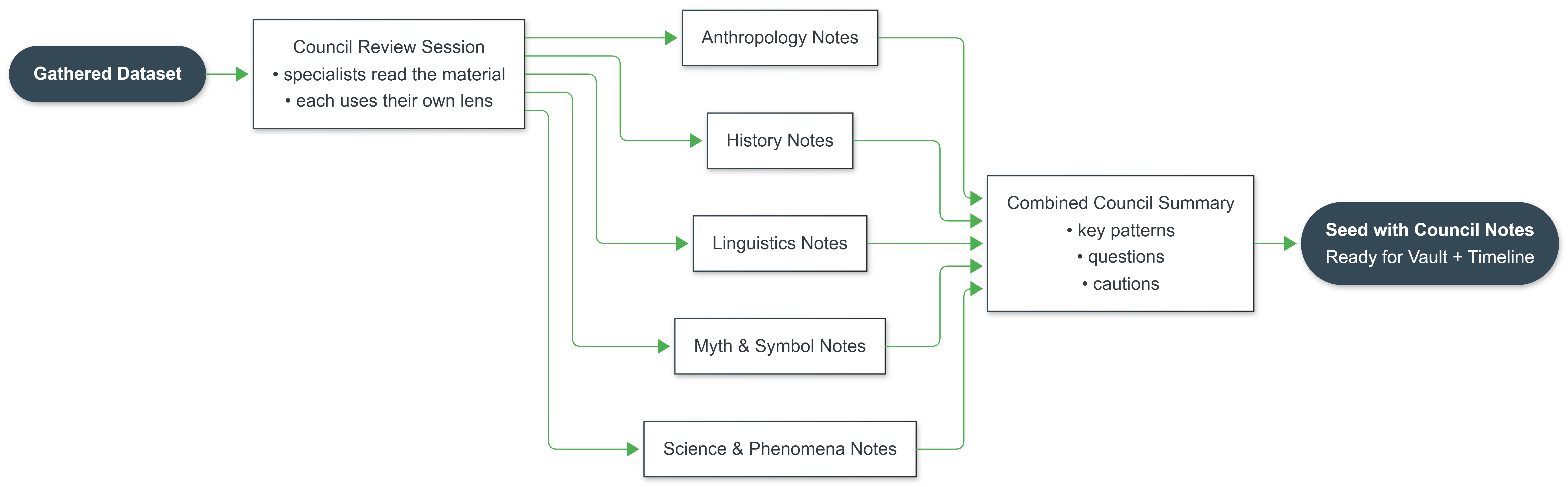
    Each seed is passed through structured interdisciplinary lenses, allowing specialists to analyze meaning, context, and significance without altering factual content. These interpretations give depth and dimensionality to the stored data.

  • Chronologist Engine

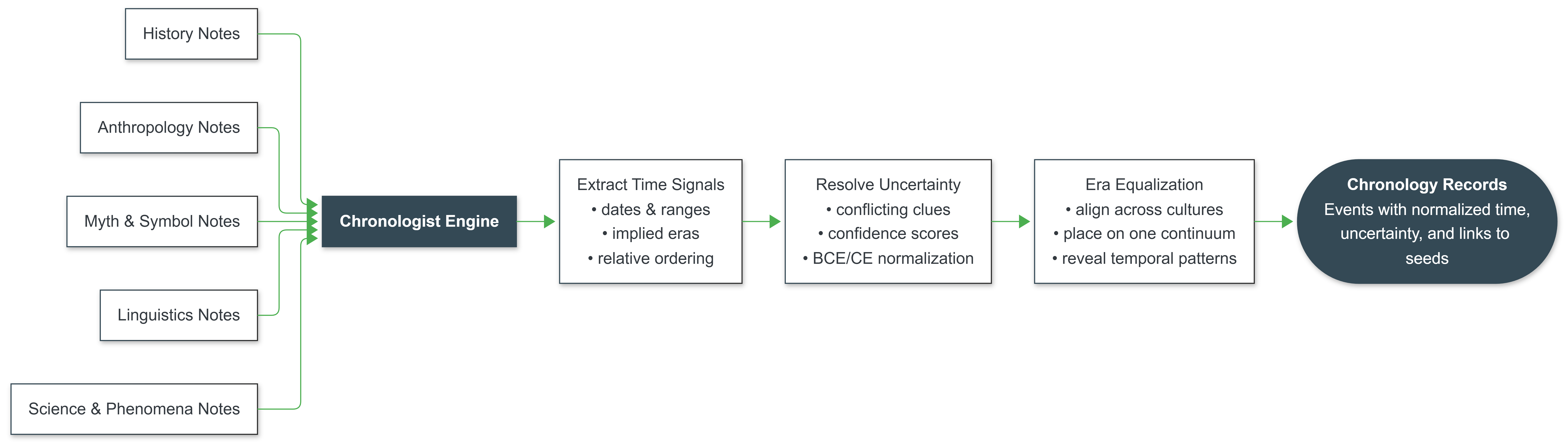
    Seeds are placed into coherent timelines using precise dates, approximations, and confidence ranges. The Chronologist weaves fragmented signals into ordered sequences, ensuring temporal consistency and providing the backbone for interpretation and visualization.

  • Librarian Oversight

    Indexing, internal search, and consistency checks maintain the accuracy and traceability of every seed and its transformations. The Librarian keeps the entire system coherent so that any piece of information can be surfaced quickly and reliably.

  • Visualization Layer

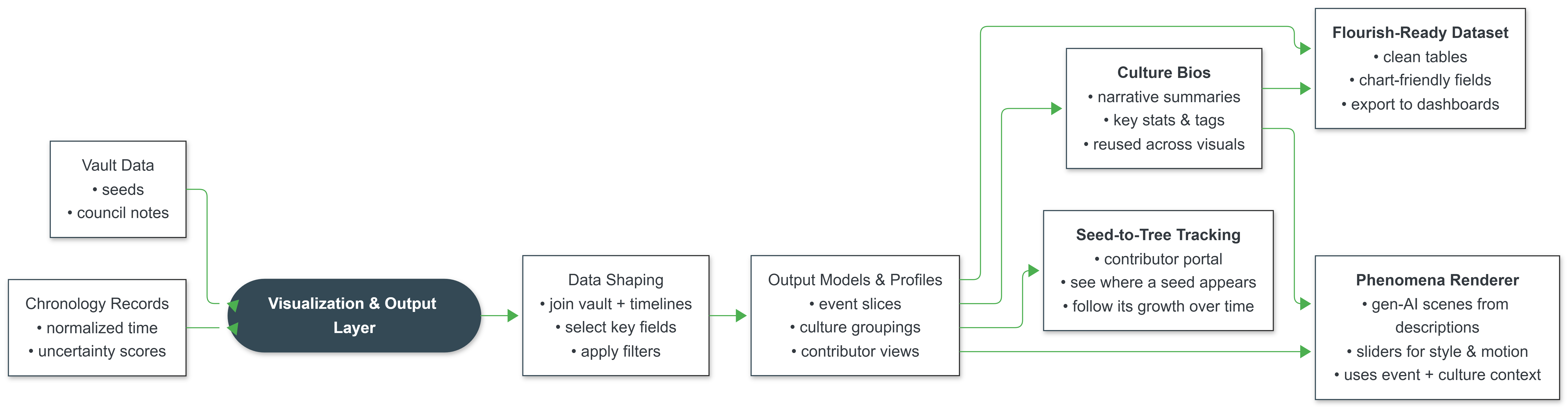
    Structured data is transformed into visual forms such as the Echo Field, timelines, or multi-layer views. These visualizations allow users to explore behavior, patterns, and relationships at a glance.

Progress Milestones

Design

Framework Defined100%

Standards & Metadata Set80%

Role Templates Drafted100%

Architecture Blueprint Complete100%

Quality Model Identified80%

System Visualization Concept Drafted100%

Implementation

Data Pipeline Operational25%

Normalization Layer Working40%

Versioning & History Enabled40%

Search & Retrieval Functional20%

Cross-System Linking Working10%

API / Access Layer Ready0%

Testing

Validation Layer Active0%

Confidence & Uncertainty Handling0%

Pattern Testing Started0%

Visualization Checks Complete0%

User-Facing Summaries Tested0%

Refinement Cycle Underway0%

Workflow Detail

Seed Architecture
Seed Architecture Workflow
Gatherer Development
Gatherer Development Workflow
Council Interpretation
Council Interpretation Workflow
Chronologist Engine
Chronologist Engine Workflow
Output & Visualization Layer
Output and Visualization Workflow

Sub Projects

The Cultural Layer

Status: Active Proof of Concept

The Light Keeper

Status: Active Design

12/8/2025 8:44pm